
If you’ve ever squinted at a goblin’s face for ten minutes trying to figure out if that’s a highlight or a dried brushstroke, this article is for you.
Lighting is the most underrated upgrade in miniature painting. Not paints, not brushes, lighting. Bad light doesn’t just make your desk uncomfortable; it actively lies to you about your colors, hides the details you’re trying to hit, and has you hunching forward like a gargoyle by the end of the session. If you want to understand exactly why light color wrecks your paint jobs, our guide to miniature painting lighting covers color temperature and CRI in plain English.
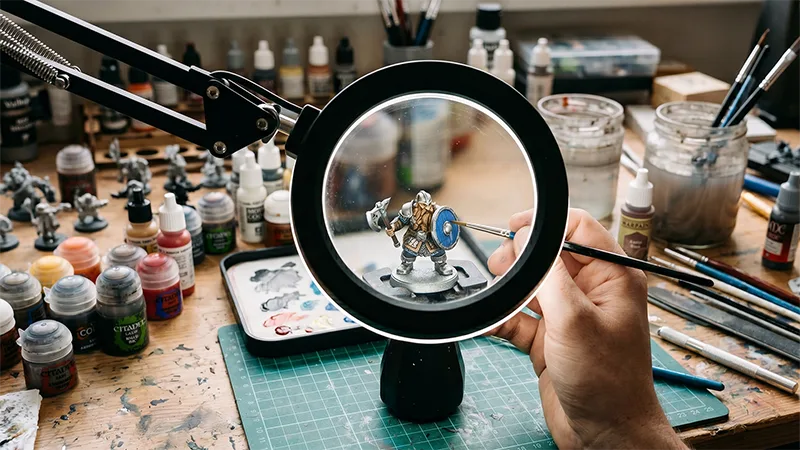
The good news: a solid magnifier lamp fixes two problems at once. You get proper daylight-balanced light that shows your paints as they actually are, plus built-in magnification that brings those tiny D&D faces into focus without needing to park your nose three inches from the mini.
Here’s our pick for the best lamp for painting miniatures in 2026, at two different price points.
What to Look for in a Magnifier Lamp
Before we get to the best lamp for painting miniatures picks, here are the specs that actually matter. You don’t need to memorize these, just know what to look for when you’re comparing options.
CRI (Color Rendering Index)
This is the big one for painters. CRI measures how accurately a light source shows colors compared to natural daylight, on a scale of 0 to 100. A CRI of 80 is fine for reading. For matching paint colors, you want 90 or higher. At CRI 90+, the difference between Ushabti Bone and Screaming Skull becomes obvious. Below that, you’re guessing.
Color Temperature
Measured in Kelvin. For miniature painting, you want daylight range: 5000K to 6500K. This is the cool, white light that shows true colors. Warm, yellowish light (below 4000K) makes everything look like it’s lit by a candle, which is lovely for mood but terrible for painting.
Magnification
For most D&D minis, 2x to 5x is the sweet spot. Higher than that and your working distance gets uncomfortably short, you’re basically touching the lamp to see through it. The real magic is in the 3x to 5x range for detail work.
Lens Material
Glass beats acrylic. Glass lenses are heavier but give a clearer, less distorted view. Acrylic lenses are fine for casual use but can show slight color fringing at the edges that gets annoying during detail work.
Arm and Clamp
You want a flexible arm that stays where you put it, and a clamp that fits your desk thickness. Most clamps handle desks up to about 2 inches thick, worth checking before you buy.
The Picks
Budget Pick: HITTI 10X Magnifying Lamp
The HITTI 10X is the entry point that doesn’t feel like a compromise. It puts out 1,800 lumens through a real glass lens, not acrylic, with three color modes and stepless dimming, meaning you can dial in exactly the brightness you want rather than jumping between fixed levels.
The 10X magnification sounds intense, but in practice it’s genuinely useful for detail work on 28mm minis. The 4.2-inch lens is wide enough to keep a whole face in frame while you’re working on it, and the ring-style LED design means light comes from all around the lens, virtually no shadows on whatever you’re looking at.
The 2026 model adds a 360-degree head rotation knob that actually works properly, which sounds like a minor thing until you’ve wrestled with a lamp head that droops mid-session.
It clamps to your desk, swings into position, and stays there. For the price, it’s hard to argue with.
Good for: Beginners, painters on a budget, anyone who wants to try magnified painting before committing to a more expensive setup.
Step-Up Pick: Neatfi Elite HD XL
If you paint more than occasionally and you care about color accuracy, the Neatfi Elite HD XL is where to spend your money.
The key upgrade over budget options is the 7-inch glass lens at 6500K daylight color temperature. That 6500K rating puts it right at the top of the daylight range, which means your Vallejo greens look like Vallejo greens and your flesh tones look like flesh tones, not whatever the warm glow of a cheap lamp tells you they look like. The glare-free design keeps eye strain down during longer sessions.
The arm is fully adjustable, clamps to your desk, and the head rotates 360 degrees. The nonpolar dimming lets you set any brightness level you want rather than stepping through preset levels.
The 7-inch lens is noticeably larger than budget options, which matters more than you’d think. When you’re working on a unit of five minis, a wider lens means you’re spending less time repositioning and more time painting.
Good for: Regular painters who want accurate color rendering, anyone working on detail-heavy minis, painters who’ve outgrown a basic desk lamp setup.
The Best Lamp for Painting Miniatures Without Magnification: Honorable Mention
If your eyesight is genuinely fine and you just want the best possible light without a magnifier built in, there’s one option worth knowing about: the Redgrass R9 Desk Lamp ($279.99, redgrasscreative.com).
The R9 is purpose-built for miniature painters. It puts out 1,800 lumens at 5000K with a CRI of 98.5+, that’s near-perfect color accuracy, better than almost anything else on the market at any price. The dual rotating LED bars eliminate shadows by letting you angle light from two directions at once, and the whole thing won a Red Dot design award, which is why it looks so good sitting on your desk.
It’s expensive and it’s not a magnifier lamp, so it doesn’t belong in the main picks for this article. But if you’re the kind of painter who invests in quality gear and already has good vision, it’s the best pure lamp you can buy.
Do You Actually Need a Magnifier Lamp?
Short answer: probably, yes, but it depends on what you’re painting.
If you’re painting 28mm D&D minis (the standard Reaper or WizKids scale), a magnifier lamp makes a real difference for faces, eyes, and any freehand detail work. Pair it with a quality detail brush and you’ll be surprised how much more you can see and control. At that scale, even 2x to 3x magnification turns a blurry smudge of a pupil into something you can actually see and correct.
If you’re painting larger models, big monsters, terrain pieces, vehicles, magnification is less critical. You might just want a high-quality daylight lamp in that case, and the R9 mentioned above is worth considering.
If you’re painting 15mm or smaller? Get the magnifier. You’ll thank yourself. And if you haven’t sorted your primer setup yet, that’s worth doing at the same time.
FAQ
What magnification is best for painting miniatures?
For most 28mm D&D minis, 3x to 5x is the practical sweet spot. It’s enough to see fine details clearly without reducing your working distance to uncomfortable levels. Higher magnifications (10x+) can be useful for specific detail work like eyes, but aren’t practical as your primary magnification level.
Does color temperature really matter for miniature painting?
Yes, significantly. According to lighting standards, a CRI of 90+ is considered high fidelity. Warm light (below 4000K) shifts everything toward yellow and orange, making it hard to judge cool colors like blues and greens accurately. Daylight-range light (5000K to 6500K) shows colors as they’ll actually look in normal conditions. If you’ve ever painted something that looked great under your desk lamp and odd everywhere else, color temperature is usually why.
Can I just use a regular desk lamp?
You can, but you’ll be fighting it. Most standard desk lamps run warm (3000K range), have relatively low CRI, and cast directional shadows that obscure the very details you’re trying to see. A decent daylight bulb in a regular lamp is a meaningful upgrade over nothing, but a dedicated magnifier lamp with proper color rendering is in a different category entirely.
Is a magnifier lamp the same as a magnifying glass with a light?
Effectively yes, a magnifier lamp combines both into one tool with an adjustable arm, which is much more practical for painting than holding a handheld magnifier. The arm keeps both hands free for your mini and your brush.
This post contains Amazon affiliate links. If you buy through them, The Mini Workshop earns a small commission at no extra cost to you. We only recommend products we’d actually use.