
Primer is the one step that can genuinely make or break a paint job. Get it right and your paints grip, your washes behave, and your highlights pop. Get it wrong and you’re fighting the model all the way through. This guide covers the best spray primers for miniatures in 2026 – what to use, when to use it, and what to avoid.
Looking for the full beginner setup? Check out our Start Here guide or browse all our Paints & Primers reviews.
Why Primer Matters More Than Beginners Expect
Bare plastic is smooth and slightly waxy. Paint applied directly won’t bond properly – it’ll flake off with handling, especially on the raised edges that get touched most. Primer creates a thin, porous surface that paint locks into. It also gives you a consistent colour base, which affects everything from how much paint you need to how accurately your final colours match the pot.
For D&D minis specifically – which tend to be plastic or resin, often fairly detailed, and painted in small batches rather than armies – spray primer is the fastest and most reliable option. A good pass takes two minutes and sets you up for a much better result than brush-on primer applied inconsistently.
The Best Spray Primers for Miniatures: Top Picks for D&D Painters
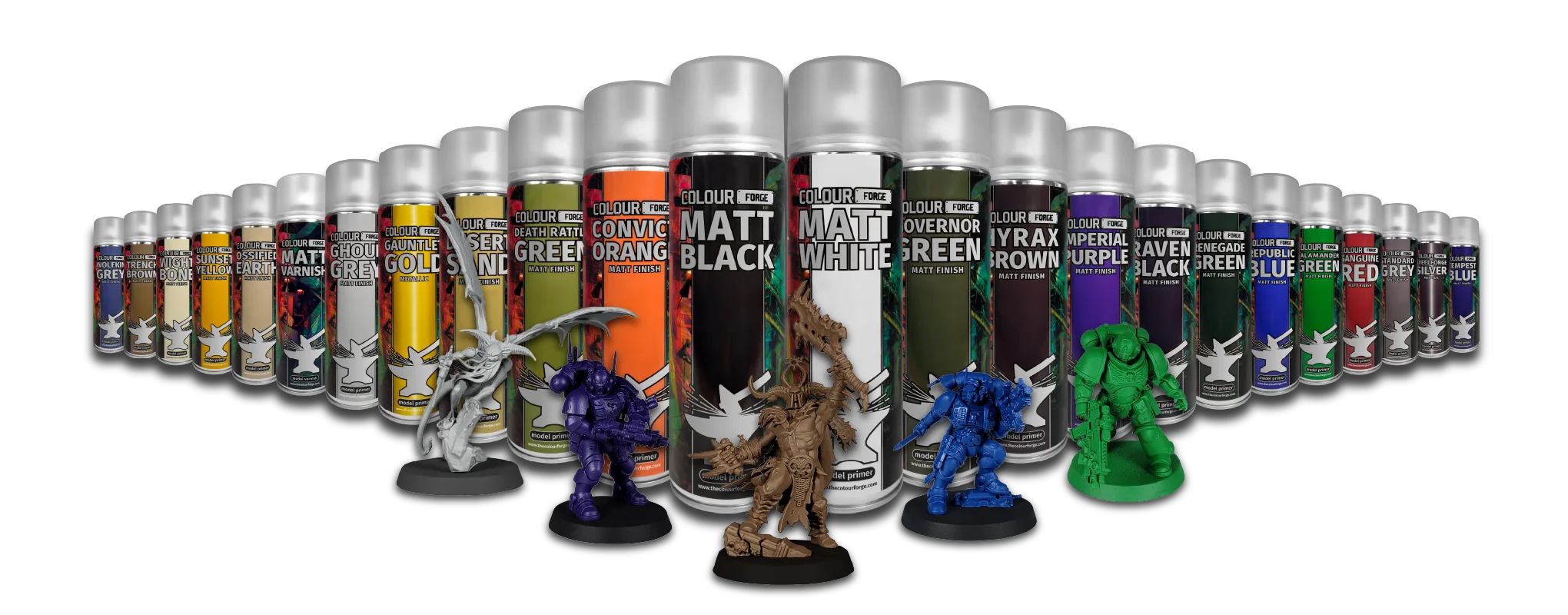
1. Colour Forge Matt Black or Matt Grey – Best Spray Primers for Miniatures – Best Value Pick
Colour Forge has become the go-to recommendation for budget-conscious hobbyists, and for good reason. Their primers come in XL 17 oz cans – about 25% more than the standard Citadel spray – at a lower price per can. The formula is smooth, consistent, and UK-made with tight quality control. Coverage is excellent and the matte finish gives paint something solid to grip.
Matt Black is the classic choice for minis where you want shadows to fill in naturally. Matt Grey is the more versatile pick – it works under both light and dark colour schemes and is the safer starting point if you’re not sure what you’re painting yet.
Browse Colour Forge primers on Amazon →
The 2026 Core Range Expansion adds 7 new XL coloured primers to the range, including a mid-brown (great for leather and fur), an off-white matched to Corax White, a purple matched to Vallejo Model Color Purple, and a new Satin Varnish. The purple is worth calling out specifically – it is the first non-GW primer colour-matched to a Vallejo shade, which makes it a useful option for D&D painters working with robes, magic, and undead schemes. The new colours are available through the Colour Forge website alongside the existing range.
2. Citadel Chaos Black – The Safe Reliable Pick
Games Workshop’s Chaos Black remains the most-used primer in the hobby. It’s specifically formulated for GW plastic, which is what most D&D starter minis are made from, and it cures to a surface texture that Citadel paints bond to perfectly. If you’re using any GW paints – Contrast, Base, or Layer – Chaos Black is the no-surprises choice.
It’s more expensive per can than Colour Forge and the cans are smaller (around 13 oz vs 17 oz), but it’s available everywhere and the consistency is rock solid. For a beginner who just wants something that definitely works, this is still a valid first purchase.
Citadel Chaos Black Spray on Amazon →
3. Citadel Grey Seer or Wraithbone – Essential for Contrast Paints
If you’re planning to use Contrast paints (or any one-coat paint system), primer colour matters a lot. Black primer kills the effect – Contrast paints are semi-transparent, so they need a light base to read correctly. Grey Seer is the standard recommendation for a cool, neutral grey base. Wraithbone gives a warmer bone-white tone that suits skintones and earthy schemes particularly well.
Colour Forge make colour-matched equivalents to both of these in their 17 oz format, which gives you the same result at better value.
Citadel Grey Seer Spray on Amazon → | Citadel Wraithbone Spray on Amazon →
4. Army Painter Colour Primers – Best for Basecoating in One Step
Army Painter primers double as basecoat colours, which is a genuine time-saver for D&D minis. Instead of priming in black and then painting a base coat, you prime in the colour you actually want and start detailing immediately. Their range covers over 30 colours – reds, blues, greens, browns – all matched to their paint range. Coverage is good, price is competitive, and the matte finish is solid.
The limitation is that you’re locked into their colour system if you want the match to work perfectly. But for someone painting a dungeon party to a tabletop standard quickly, it’s a genuinely efficient approach.
Browse Army Painter Colour Primers on Amazon →
5. Vallejo Surface Primer – Best for Airbrushing
If you own or are planning to get an airbrush, Vallejo Surface Primer is the benchmark. It comes in dropper bottles (0.6 oz and 6.8 oz), is self-levelling, extremely fine-grained, and bonds well to plastic, resin, and metal. The finish is smooth enough that fine detail on character minis – faces, hair, fabric folds – stays crisp.
It’s not really a spray can product, so skip it if you’re working without an airbrush. But the 6.8 oz bottle at around $7–$10 is dramatically cheaper per model than any spray option.
Vallejo Surface Primer on Amazon →
Which Colour? A Guide to the Best Spray Primers for Miniatures
Black primer is the most forgiving choice for beginners. Unpainted spots read as deep shadow rather than a bright error. It naturally darkens recesses, which means your washes and shading have a head start. Best for: dark armour, monsters with natural shadow, any model where you want a moody, gritty feel.
White primer gives the most vibrant colours – yellows, oranges, and bright reds are dramatically better over white. The downside is that missed spots are glaringly obvious as bright patches. Best for: bright schemes, light-coloured robes, undead with pale skin.
Grey primer is the safe middle ground and the best starting point if you’re unsure. It gives some natural shadowing, allows good colour vibrancy, and is forgiving of minor coverage issues. Best for: beginners, mixed parties with varied colour schemes, anything where you don’t have a strong preference.
Spray Primer Tips That Actually Matter
- Temperature is everything. Don’t spray below about 60°F (15°C) or in humid conditions. Cold air causes grainy, chalky primer that kills detail. If in doubt, take the model indoors and use a brush-on primer instead.
- Shake the can for two full minutes before you start, and shake periodically as you go. An under-mixed can is one of the main causes of uneven coverage.
- Keep moving. Short sweeping passes from about 10–12 inches away. Never hold the can still over a model – you’ll get runs and fill in fine detail.
- Two thin coats beat one heavy one. Let the first pass dry for 10 minutes before the second. Thick primer is the fastest way to lose the detail on a face or a textured base.
- Prime before assembly where possible. Hard-to-reach areas – under cloaks, inside chest cavities – are much easier to prime as separate pieces.
What to Avoid
Cheap hardware store primer is the most common beginner mistake. It works fine on furniture but the particle size is too coarse for miniature-scale detail – you’ll lose the texture on faces and armour before you’ve even picked up a brush. Stick to hobby-specific products.
The other common issue is priming in bad weather and not realising until the paint goes on. If your primer looks slightly rough or powdery rather than smooth and matte, bad conditions are usually the cause. Strip the model with isopropyl alcohol and start again – it’s faster than trying to paint over chalky primer.
The Bottom Line: Best Spray Primers for Miniatures in 2026
For most D&D painters, the recommendation is straightforward: Colour Forge Matt Grey for the best value in a versatile everyday primer, Citadel Grey Seer if you’re going heavy on Contrast paints and want the guaranteed GW-formula result, and Army Painter Colour Primers if you want to basecoat and prime in a single step. All three are solid choices that won’t hold back your paint jobs.
One more tip while you’re setting up your painting space: good lighting matters as much as good primer. If you’re still painting under a regular desk lamp, our guide to the best lamp for painting miniatures is worth a read before your next session.
As an Amazon Associate, The Mini Workshop earns from qualifying purchases.