
One of the fastest ways to make a D&D miniature look like it belongs in an actual dungeon is weathering. Rust on old iron bars. Green corrosion creeping across a bronze dragon’s hoard. Moss clinging to a forgotten statue. The problem is that most tutorials assume you want to spend hours layering and drybrushing to get there.
Patina paints skip all of that. You brush them on, they react, and the effect develops on its own. No technique required. Two brands have dominated this niche for years: Dirty Down, which has been the go-to for miniature painters and prop makers alike, and Green Stuff World, which released its own water-soluble patina range in mid-2026 and immediately invited comparison.
This article breaks down both products so you can decide which one belongs in your kit.
What Patina Paints Actually Do
A patina is the natural discoloration that builds up on metal over time. Copper turns green. Iron goes orange-brown. Stone gets mossy. Patina paints are formulated to replicate those effects on miniature surfaces without the usual multi-step weathering process.
The way they work is different from regular acrylic paint. You apply them like a wash, but instead of simply shading recesses, they oxidize as they dry. Pigments settle into surface texture and crevices, creating variation that looks organic rather than painted. Both Dirty Down and Green Stuff World use this same basic principle, but they get there through different chemistry and with some notable differences in the result.
One thing both products share: you need to seal them with matte varnish when you are done. These paints stay water-reactive after drying, which means sweat, humidity, or accidental moisture can reactivate the effect. For gaming minis that get picked up regularly, this step is not optional.
Green Stuff World Water-Soluble Patina Paints
Green Stuff World released six patina colors in 2026: Verdigris, Turquoise Oxide, Yellow Oxide, Moss, Black Soot, and Filthy Dirt. They are available individually in 60ml bottles, in a larger 240ml size, and as a six-color 60ml starter set.
For D&D painters, each color has an obvious use case:
Verdigris
The classic green-blue oxidation on copper and bronze. Use it on metallic dragons, old coins, relics, enchanted items, and antique armor. This is the one most people reach for first.
Turquoise Oxide
A stronger blue-green variation, leaning cooler. Good for heavily corroded fantasy armor and decorative metalwork that needs a more dramatic oxidized look.
Yellow Oxide
Creates warm rust tones on iron and steel. Perfect for rusty dungeon gates, battered weapons, chains, and aged hardware in dungeon terrain.
Moss
Adds organic green growth to stone and porous surfaces. Ruined dungeon walls, ancient statues, gravestones, and any terrain that has been sitting in a damp cave for centuries.
Black Soot
One of two colors with no Dirty Down equivalent. It adds smoke staining, burn marks, and dark residue around torches, braziers, and anything near fire. Also useful for grimdark scenery.
Filthy Dirt
The other exclusive. Creates grime, dust, and dried mud effects on bases and lower surfaces. Boots, dungeon floors, the lower panels of walls and doors.
The formula is acrylic, water-based, and non-toxic. No fumes, no ventilation required, no special handling. Each bottle comes with a nozzle cap that needs to be pierced before first use. The patina paints can gunk up the nozzle over time, so keeping a pin handy is worth it. The consistency is similar to a thin wash, and shaking or gently stirring before use is a good idea.
GSW sells these direct from their website. They are not currently available on Amazon.
Dirty Down Patina Paints
Dirty Down has been the hobbyist’s patina standard for years. The range covers four effects: Rust, Yellow Rust, Moss, and Verdigris. These come in 25ml and 250ml sizes.
The four D&D applications mirror three of the GSW colors: verdigris for corroded metal, rust for aged iron, and moss for organic growth. Yellow Rust gives a lighter, warmer rust tone compared to the standard Rust Effect.
Dirty Down is marketed as water-soluble, which is technically true in the sense that you can reactivate it with water. But the formula actually contains alcohol, acetone, and xylene, which makes it alcohol-based rather than water-based in the way you might expect. In practice, this means it gives off fumes during application. You want decent ventilation when using it, and repeated use warrants a respirator rated for organic vapors.
On the upside, Dirty Down’s solvent content gives it some blending properties that the GSW range lacks. You can feather the effect with a damp brush or lift some of it off after application to create streaks and transitions. This does require an extra step and a bit of practice. Reviewers have also found that warming the paint slightly and mixing in a small amount of water before applying gives stronger results than straight-from-the-pot use.
Dirty Down is available on Amazon in the 25ml size. The 250ml is available through some third-party sellers at significantly marked-up prices; the normal retail route for larger quantities is through hobby distributors.
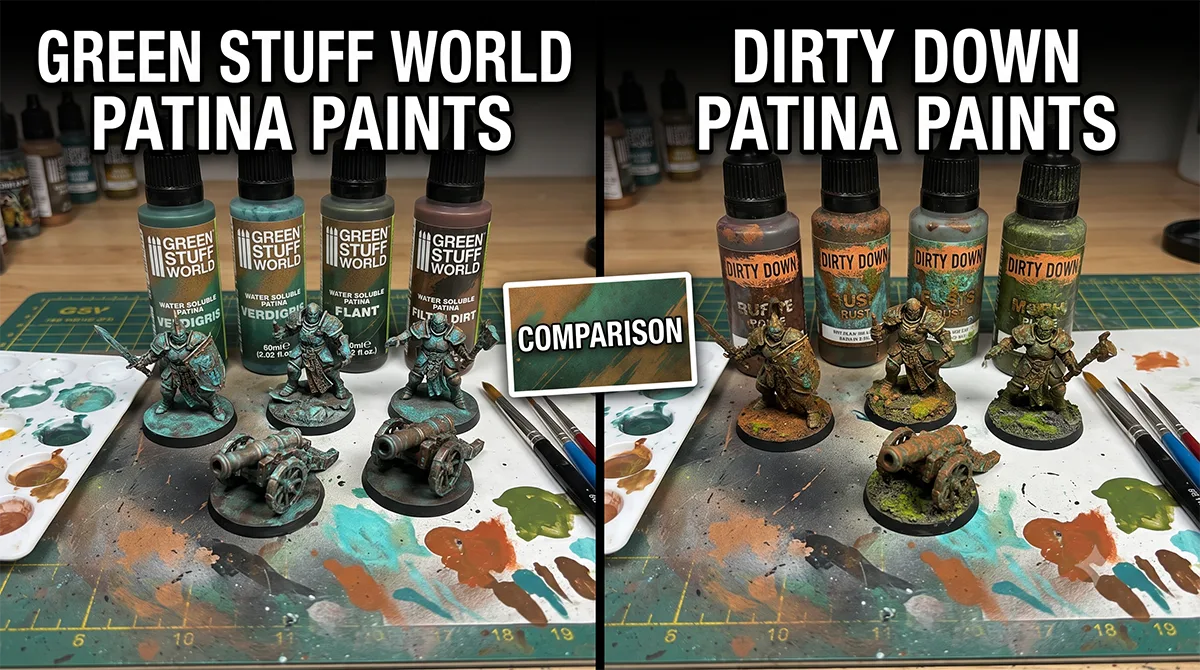
Head-to-Head: The Overlapping Colors
Verdigris
This is where GSW pulls ahead most clearly. The two GSW verdigris colors give you options, and they produce a stronger, more saturated oxidation effect straight out of the bottle. The Dirty Down Verdigris effect is more subtle by default, and getting the most out of it takes reactivation work. For D&D painters who want quick, convincing results on copper dragons or relics, GSW lands more reliably.
Rust
The GSW Yellow Oxide is consistent and works well across different surface colors. Dirty Down Rust gives you more control when you reactivate with water, which experienced painters may prefer for subtle effects. For beginners, GSW is more forgiving.
Moss
Both perform similarly here. The effect quality is comparable. If you already have one brand, you probably do not need the other just for moss.
What Dirty Down Doesn’t Have
GSW’s Black Soot and Filthy Dirt have no equivalent in the Dirty Down range. For D&D painters building lived-in dungeons, these are genuinely useful. Soot lets you add fire damage and smoke staining without a separate product. Filthy Dirt handles muddy bases and grime buildup in a way that is hard to replicate with a regular wash.
If these effects interest you, the GSW set is the only place to get them in this format.
The Safety Question
This is worth stating plainly. Dirty Down contains alcohol, acetone, and xylene. These are flammable chemicals with real ventilation requirements. If you paint indoors at a small table, or if you have kids or pets nearby, this matters. Dirty Down products cannot be shipped by air due to their flammable classification.
The GSW range is acrylic, water-based, and non-toxic. It is the more comfortable option for most home painters.
Which Should You Buy?
For most D&D painters: Green Stuff World. The six-color starter set gives you everything in generous 60ml bottles, the formula is safer to use indoors, and the effects are stronger and more consistent straight from the bottle. The extra colors (Soot and Filthy Dirt) are genuinely useful and have no equivalent elsewhere.
For painters who want maximum blending control: Dirty Down’s solvent content lets you feather and manipulate the effect in ways the GSW range cannot quite match. If you are comfortable with the fumes and willing to learn the extra technique steps, the control ceiling is higher.
If you are picking one to start with, the GSW set is the better introduction to patina paints for the D&D audience.
One note that applies to both: patina paints produce somewhat variable results depending on your base coat color and surface texture. They work best on metallic base coats and are less effective over very dark primers. Testing on a spare piece before committing to a finished mini is always a good idea.
Where to Buy
Dirty Down is available on Amazon in 25ml pots:
- Dirty Down Rust Effect on Amazon
- Dirty Down Verdigris on Amazon
- Dirty Down Yellow Rust on Amazon
- Dirty Down Moss Effect on Amazon
Green Stuff World Water-Soluble Patina Paints are available directly from the Green Stuff World website, individually or as the six-color starter set:
Green Stuff World Water-Soluble Patina Set (GSW website)
One More Thing: You Need a Matte Varnish
Both patina paints stay water-reactive after drying. That means humidity, handling, or even slightly damp fingers can shift the effect. A coat of matte varnish locks everything in and protects the finish for gaming use.
Spray application is the way to go here. Brushing varnish over patina effects can reactivate them before they are fully sealed. The Army Painter Anti-Shine Matt Varnish is the standard community pick and works well over both GSW and Dirty Down effects.
Army Painter Anti-Shine Matt Varnish on Amazon
As an Amazon Associate, The Mini Workshop earns from qualifying purchases. This helps support the site at no extra cost to you.